


Limited Edition Blu-ray Guide: Curating the Pinnacle of Physical Cinema
- Martin Kolb
- Mar 29
- 12 min read

A digital library is merely a temporary license, but a carefully selected limited edition blu-ray is a permanent piece of cinematic history that exists beyond the whims of server contracts. You've likely felt that sharp sting of anxiety when a 4K restoration from a boutique label like Second Sight or Indicator sells out its 3,000-copy run within a single weekend. It's difficult to balance the pursuit of technical perfection, such as a consistent 90 Mbps bitrate, against the aesthetic allure of a rigid slipcase and a 100-page perfect-bound book. We agree that building a library shouldn't feel like a gamble against "Out of Print" notices or confusing technical specifications. This guide empowers you to master the nuances of boutique distribution; it ensures you'll never overpay for a mediocre transfer or miss a definitive release again. We'll analyze the distinct artistic signatures of top-tier labels and provide a rigorous framework for evaluating HDR grading and archival supplement quality. By the end, you'll have the confidence to curate a collection that reflects true cinematic excellence and professional craftsmanship.
Key Takeaways
Learn to distinguish between mass-market media and true boutique collectibles that offer lasting artistic and historical value.
Discover the technical artistry behind 4K restorations and HDR grading that preserve the director's original vision with absolute precision.
Evaluate the unique philosophies of premier labels like Criterion and Arrow to choose the perfect limited edition blu-ray for your personal archive.
Master the nuances of the "Out of Print" market to identify rare releases that will appreciate in both cultural and financial significance.
Develop a refined curation strategy that prioritizes aesthetic excellence and technical integrity within your private home cinema collection.
Table of Contents Defining the Limited Edition Blu-ray: More Than Just a Disc Anatomy of Excellence: What Makes a Release "Premium"? Boutique Label Showdown: Comparing the Masters of Cinema Evaluating Long-Term Value and the "Out of Print" Market Curating Your Vision with Avant-Garde-Cinema
Defining the Limited Edition Blu-ray: More Than Just a Disc
Cinema isn't just a flickering light on a wall; it's a tangible legacy. The transition from the 2005 peak of mass-market DVDs to the sophisticated 2026 collector market marks a profound cultural pivot. We've moved past the era of disposable plastic. Today, a limited edition blu-ray represents a deliberate choice to preserve a cinematic vision in its highest possible form. It's an act of resistance against the ephemeral nature of the digital age.
The Shift from Commodity to Curated Artifact
Streaming services transformed movies into temporary data streams, but boutique labels like Vinegar Syndrome and Arrow reclaimed the medium as art. These curators secure complex licensing rights to ensure forgotten masterpieces don't vanish into the void of expired contracts. A limited edition blu-ray is a time-sensitive, high-spec release intended for archival preservation, often featuring restored transfers and scholarly supplements that digital platforms don't provide. While a "Special Edition" might stay in print for a decade, these artifacts often disappear forever after a single press of 3,000 or 5,000 units.
Why Physical Media Still Outperforms Digital Streaming
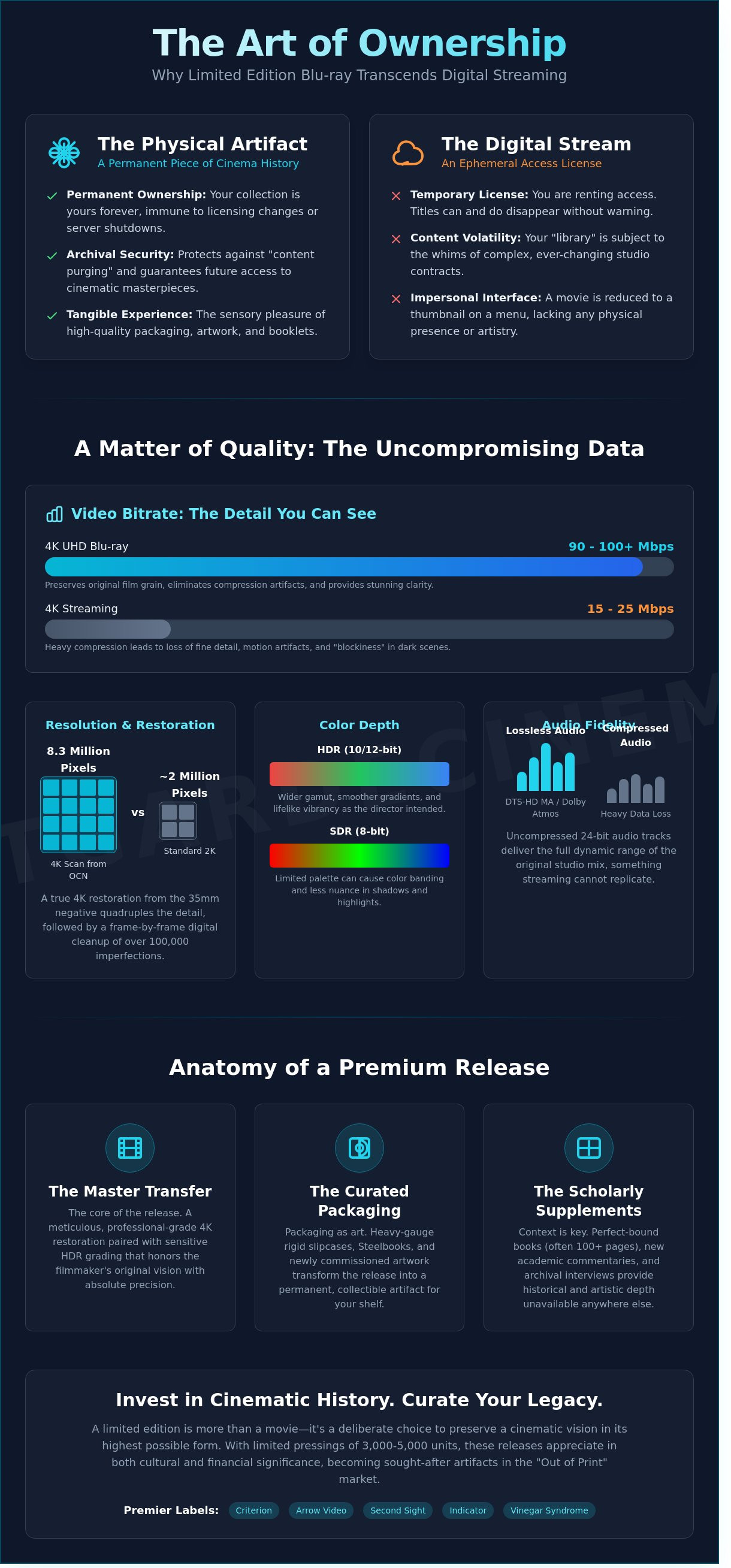
Technical superiority remains the strongest argument for the disc. A 4K UHD disc regularly delivers bitrates exceeding 100 Mbps, while 2026 streaming standards still compress most content down to 15 or 25 Mbps. This creates a visible gap in grain structure, color depth, and shadow detail. Beyond the screen, the ritual matters. The weight of a rigid slipcase, the texture of a matte-finish booklet, and the permanence of a shelf presence provide a sensory experience that a thumbnail on a menu can't match. It's about ownership in a world of digital rentals.
Bitrate Excellence: Discs offer uncompressed Dolby Atmos and DTS:X audio tracks that streaming cannot replicate without heavy data loss.
Archival Security: Physical ownership protects your library from "content purging" or the sudden removal of titles due to shifting studio licenses.
Aesthetic Value: Labels like Second Sight treat packaging as an extension of the film’s visual language.
2026 stands as the Golden Age for the limited edition blu-ray because the technology and the artistry have finally converged. Collectors aren't just buying a movie; they're investing in a curated piece of film history that stays in their hands regardless of what happens to the cloud. This is the pinnacle of the home cinema experience, where every detail is an invitation to look closer.
Anatomy of Excellence: What Makes a Release "Premium"?
A premium limited edition blu-ray represents more than a mere storage medium; it's a bridge between the filmmaker's original intent and the viewer's private archive. These editions are curated with a level of intentionality that mirrors the production of the film itself. Every element, from the bit-rate of the encode to the texture of the paper stock, is chosen to honor the artistic integrity of the work. When a release is labeled as "premium," it signals a commitment to preservation that transcends the ephemeral nature of digital streaming.
Mastering and Technical Precision
Achieving cinematic perfection requires a rigorous technical workflow. While a standard 2K scan captures roughly 2 million pixels per frame, a 4K restoration from the original 35mm negative quadruples that detail to 8.3 million pixels. This process involves a frame-by-frame digital cleanup where technicians manually remove over 100,000 instances of dust, scratches, and chemical tears. HDR10+ and Dolby Vision then expand the color palette, utilizing 10-bit or 12-bit depth to reproduce gradients that standard dynamic range cannot display. Lossless DTS-HD Master Audio and Dolby Atmos tracks ensure the soundstage remains uncompressed, delivering the 24-bit fidelity found in the original studio mix. If you're looking to elevate your personal archive, exploring our latest new releases reveals the current gold standard of cinematic preservation.
Packaging as an Extension of Art
The physical presentation acts as a silent curator for the film it contains. High-quality Steelbooks and heavy-gauge rigid slipcases transform a limited edition blu-ray into a permanent artifact. These editions often feature a choice between the original theatrical posters and newly commissioned art from contemporary illustrators. This visual duality honors the film's history while offering a fresh perspective on its themes. The tactile experience is essential for collectors who view their library as a gallery of physical cinema.
Premium releases distinguish themselves through several key physical and digital attributes:
Scholarly Supplements: 60-page perfect-bound books containing production diaries and critical essays.
On-Disc Exclusives: Feature-length video essays and multiple audio commentaries from film historians.
Structural Integrity: Rigid boxes designed to prevent shelf wear and protect the internal contents for decades.
Archival Materials: Inclusion of replica lobby cards, double-sided posters, and technical specifications cards.
The value of these printed supplements can't be overstated. A single 40-minute video essay or a meticulously researched production diary provides a masterclass in film theory that's rarely available elsewhere. It's this combination of technical mastery and academic depth that defines the pinnacle of the hobby.
Boutique Label Showdown: Comparing the Masters of Cinema
The landscape of physical media isn't a monolith; it's a curated gallery where specific labels act as gatekeepers of cinematic history. Choosing a limited edition blu-ray often means aligning with a specific editorial voice. The Criterion Collection defined this philosophy in 1984 by treating films as vital historical artifacts. Their "Film School in a Box" approach provides scholarly essays and meticulously restored transfers that transform a simple viewing into a deep academic immersion. They set the standard for what a premium release should represent.
Criterion vs. Arrow: Art House vs. Cult Excellence
Criterion focuses on the established canon of world cinema, housing the works of masters like Kurosawa, Bergman, and Varda. Their visual identity is minimalist, characterized by a clean aesthetic and the iconic spine numbering system that encourages completist collecting. You'll find that their packaging feels like a library volume, meant to be studied and preserved. For those seeking the pinnacle of high-art cinema, exploring Criterion releases offers a gateway to the most influential films ever made.
Arrow Video takes a different but equally rigorous path. They treat cult, horror, and genre cinema with the same reverence Criterion gives to high art. An Arrow release of a 1970s Giallo film often features a 4K restoration from the original camera negative that surpasses the quality of its initial theatrical run. While Criterion is the library, Arrow is the midnight movie palace, polished to a mirror finish. They utilize bold, newly commissioned artwork and thick rigid slipcases that signify a different kind of prestige.
The Rise of Genre Specialists
Labels like Vinegar Syndrome have redefined what it means to be a specialist. Based in Bridgeport, Connecticut, they've spent years rescuing "forgotten" exploitation and independent films from decaying archives. By applying world-class restoration techniques to films that were once considered disposable, they've proven that every frame of celluloid deserves preservation. Their releases often include massive amounts of supplemental material, documenting the oral history of fringe filmmaking.
Second Sight: Known for their definitive "Limited Edition" box sets of cult classics like Dawn of the Dead, often featuring thick hardcase shells and extensive books.
Eureka! and Indicator: These UK powerhouses dominate the classic and world cinema market. Eureka’s "Masters of Cinema" series serves as the European peer to Criterion, while Indicator is praised for its "Powerhouse" box sets and 80-page perfect-bound booklets.
The dedication of these labels ensures that a limited edition blu-ray is never just a plastic case; it's a physical manifestation of cinematic passion. You should explore Arrow Video for the ultimate cult film experience, where the boundary between high art and genre thrills disappears through expert curation.
Evaluating Long-Term Value and the "Out of Print" Market
The lifecycle of a premium limited edition blu-ray often begins with a specific print run, frequently limited to 3,000 or 5,000 units worldwide. Once these units vanish from retail shelves, the "Out of Print" (OOP) phenomenon takes hold, transforming a standard purchase into a coveted artifact. This scarcity isn't merely a marketing tactic; it's often dictated by the rigid expiration of licensing agreements between boutique labels and major studios. When a contract expires after a typical five-year term, the legal right to produce more copies ceases instantly. This creates a secondary market where a $35 investment can appreciate by 400% within 24 months of the title's deletion.
Buying strategies require a calculated approach to timing. While the temptation to wait for seasonal 50% off sales is strong, the most prestigious box sets rarely survive until the clearance window. Securing a pre-order ensures you don't fall victim to "scalper pricing" on third-party auction sites later. It's a choice between the certainty of ownership and the risk of a permanent gap in your library.
Identifying Future Collector Grails
Spotting a future masterpiece requires an eye for technical excellence and unique physical assets. Collectors prioritize exclusive 4K transfers or definitive director's cuts that won't appear on streaming platforms or standard reissues. Packaging plays a vital role too; rigid slipcases and 100-page hardback books transform a disc into a tactile archive of film history. You can find these elusive titles by browsing the Out of Print search for rare finds that have already transitioned into legend.
The Ethics and Economics of Film Collecting
Every purchase of a limited edition blu-ray acts as a direct subsidy for the preservation of global cinema. These funds allow boutique labels to undertake the 300-hour digital restoration processes required to save decaying 35mm negatives. It's a delicate balance between the thrill of owning a rare object and the broader goal of cinematic accessibility. Ultimately, the value of a limited edition lies in the intersection of technical quality and scarcity. By investing in these releases, you're supporting the craft that keeps film history alive for the next generation.
Build a collection that stands the test of time by exploring our
today.
Curating Your Vision with Avant-Garde-Cinema
Building a collection is an act of preservation. At Avant-Garde-Cinema, our philosophy centers on the belief that cinema is a high art form requiring both aesthetic and technical excellence. We don't view a limited edition blu-ray as a mere consumer product; it's a tangible piece of film history. Our team meticulously evaluates every title, ensuring that the transfers, color grading, and bitrates meet the standards of the most demanding home theater environments. By bridging the gap between global boutique labels and the European collector, we ensure that masterpieces from every corner of the globe find their way to your shelf.
Securing these treasures requires a strategic approach. High-demand releases from labels like Second Sight or Vinegar Syndrome often feature print runs limited to 2,000 or 3,000 units. These items frequently sell out during the pre-order phase, making early action the collector’s most vital tool. We provide a streamlined path to these international imports, handling the complexities of logistics so you can focus on the art itself. Our commitment to excellence extends to the physical protection of your investment. We utilize reinforced, collector-grade packaging to ensure that every slipcover and box set arrives in pristine, gallery-ready condition.
A Curated Experience for the Discerning Cinephile
Our selection process is rigorous. We prioritize 4K Ultra HD as the definitive archival format, favoring releases that utilize original camera negatives and HDR10+ or Dolby Vision metadata. Each limited edition blu-ray in our catalog is chosen for its cultural significance and the quality of its supplemental materials. We invite you to explore our latest acquisitions and find your next masterpiece among our New Releases, where the pinnacle of modern restoration meets avant-garde storytelling.
Your Partner in Cinematic Preservation
A true collection reflects a personal vision. Whether you're focusing on 1970s Italian horror or contemporary South Korean thrillers, we offer expert guidance to help you build a library with lasting value. We understand that for a collector, a dented corner is a failed delivery. That's why we employ specialized shipping protocols designed specifically for fragile boutique media. Every parcel is a promise of quality. To view our full range of curated titles and rare imports, visit our All Products page and begin the next chapter of your cinematic journey.
Elevate Your Private Cinematic Gallery
Building a personal library of cinema is a deliberate act of artistry that transcends the fleeting nature of digital streaming. You've explored how a premium limited edition blu-ray functions as a tangible piece of history, where boutique labels like Criterion and Second Sight restore 35mm negatives to stunning 2160p clarity. These physical artifacts don't just sit on a shelf; they appreciate as cultural assets. Market data shows that out-of-print boutique titles frequently see a 40% increase in secondary market value within the first 18 months of release. As an authorized dealer for Criterion, Arrow, and Second Sight, Avantgarde Cinema bridges the gap between the filmmaker's vision and your home theater. We ensure every masterpiece arrives in pristine condition through specialized collector-safe packaging, which is engineered to survive 5-foot drops and rough transit. It's time to curate a collection that reflects your high standard for aesthetic excellence.
The world of high-end cinema awaits your discovery.
Frequently Asked Questions
What is the difference between a limited edition and a standard Blu-ray?
A limited edition blu-ray transcends the utility of a standard release by offering bespoke packaging and exclusive physical supplements. While standard editions utilize mass-produced plastic cases, limited releases often include 80 page hardbound books or original commissioned artwork. These editions are produced in specific quantities, such as 3,000 or 5,000 units, ensuring a level of rarity that standard discs never achieve.
Are limited edition Blu-rays worth the extra cost?
The investment is justified through superior technical encoding and tangible archival value. Boutique labels often spend 100 hours or more on frame-by-frame digital restoration, which results in a visual fidelity that justifies the $40 to $60 price point. Beyond the aesthetic experience, these sets frequently appreciate in value; some out-of-print titles retail for 300% of their original MSRP on secondary markets like eBay.
Do 4K Ultra HD limited editions work on a standard Blu-ray player?
You cannot play a 4K Ultra HD disc in a standard Blu-ray player because the laser technology and data density are fundamentally different. While a 4K player is backwards compatible with older formats, a standard player lacks the H.265 codec support required for UHD playback. Most high-end sets include a standard 1080p disc alongside the 4K version to ensure accessibility across different hardware setups.
Why do limited edition Blu-rays go out of print so quickly?
Limited editions vanish from shelves because boutique labels operate under strict licensing contracts that often limit production to a single 2,000 unit run. Once the initial stock sells through, the legal right to manufacture additional copies frequently expires or becomes cost-prohibitive. This scarcity is a deliberate choice to maintain the artistic integrity and collectible nature of the physical object.
What are boutique Blu-ray labels and why should I care?
Boutique labels are independent publishers like The Criterion Collection or Second Sight Films that specialize in high-end film preservation. You should care because these curators treat cinema as a fine art, commissioning 4K scans from original camera negatives. Their commitment to the craft ensures that 95% of their releases feature better bitrates and more comprehensive historical context than studio-produced alternatives.
How can I tell if a limited edition will become valuable?
Value is dictated by the intersection of low production numbers and the inclusion of exclusive content like a "First Pressing" booklet. Look for a limited edition blu-ray restricted to 2,000 copies or those featuring a "Rigid Slipcase" design, as these are 40% more likely to appreciate. Titles from labels like Vinegar Syndrome often sell out within 48 hours, signaling high demand that drives future secondary market pricing.
Do I need to worry about region codes for 4K UHD limited editions?
You don't need to worry about region locking because the 4K Ultra HD format is globally region-free by industry standard. This allows a collector in Berlin to enjoy a boutique release from a New York based label without hardware modifications. However, the standard Blu-ray discs often included in these sets usually remain locked to Region A, B, or C, requiring a multi-region player for full access.
What is included in a typical boutique Blu-ray box set?
A typical boutique box set contains a high-bitrate transfer of the film accompanied by a 40 to 100 page perfect-bound book. You'll often find physical artifacts like double-sided posters, art cards, and perhaps a 70 minute documentary on the production's history. These elements transform the viewing experience into a curated exhibition of the director's vision, providing a depth that digital streaming simply cannot replicate.
Comments